Central Vietnam expresses itself in miniature. Banh beo, banh nam, and banh bot loc are steamed rice cakes no bigger than a coin, topped with shrimp and eaten with sweet fish sauce. You do not need to fly to Hue: Saigon has excellent Hue kitchens. This is your guide to ordering them with confidence.
AI illustration
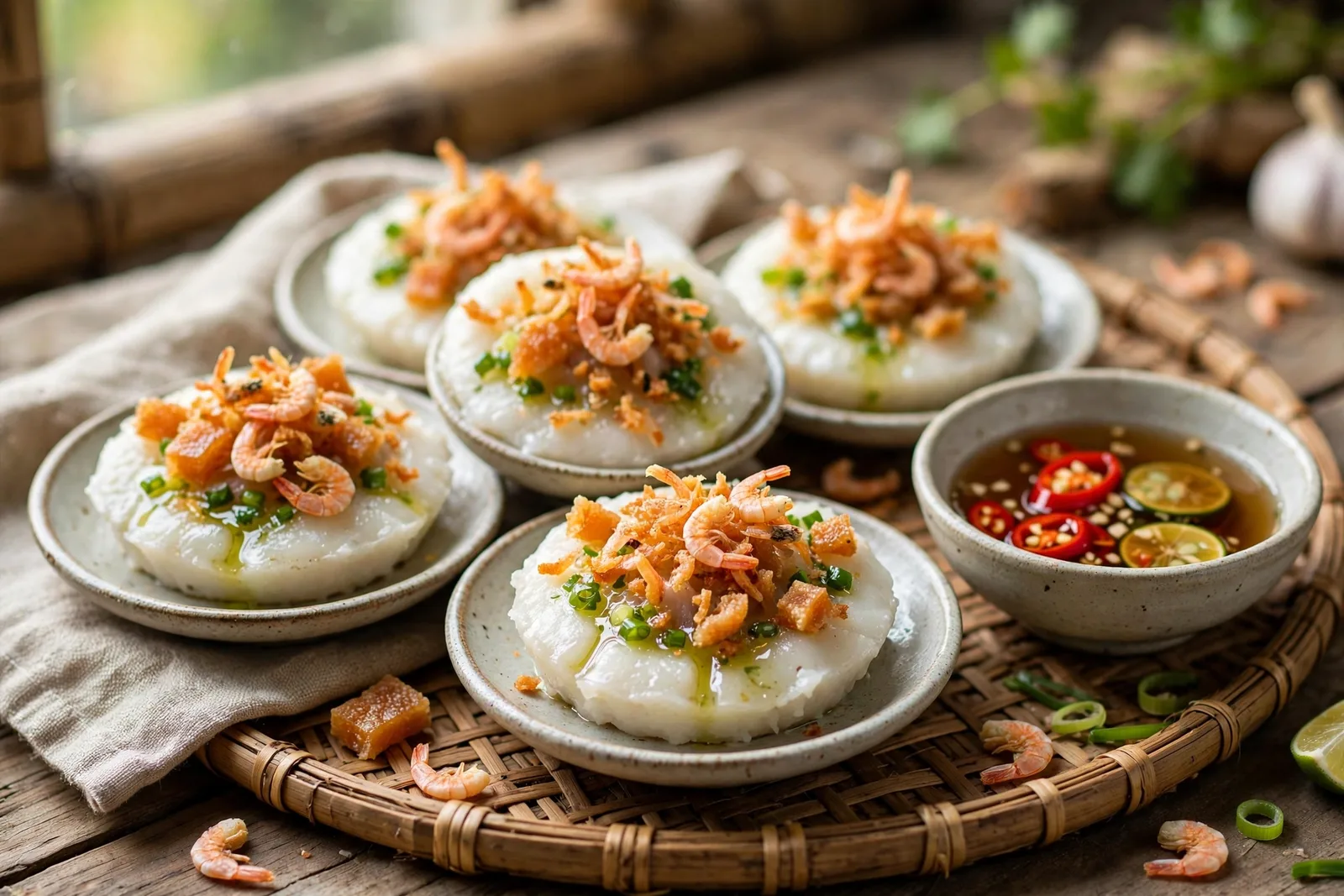
Banh beo is the icon: a delicate steamed rice batter set in a tiny ceramic dish, topped with dried shrimp, crispy pork skin, and scallion oil. You eat it straight from the dish with a small spoon, flooding it with sweet nuoc cham. One is a bite, ten is a snack, twenty is dinner.
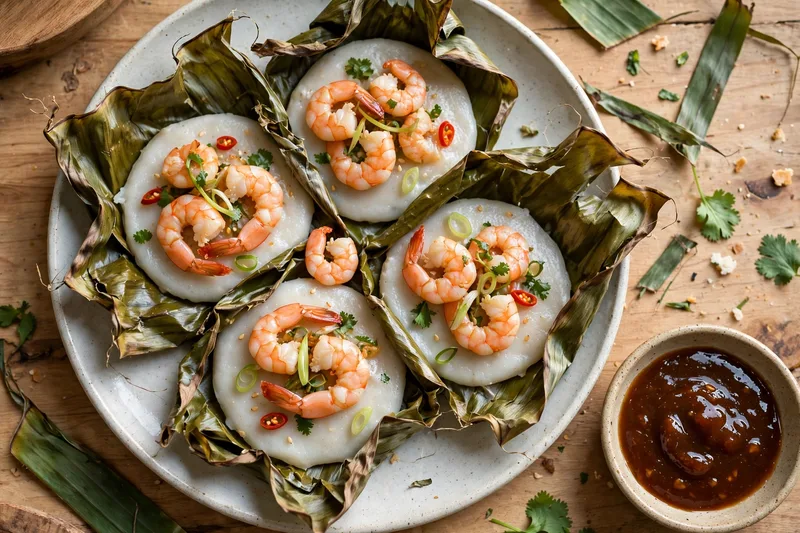
Banh nam goes flatter and wider. The rice batter is steamed in a banana leaf into a soft rectangular sheet, topped with shrimp and minced pork, then unwrapped at the table. The leaf perfumes the cake, and peeling it open is half the pleasure. Banh bot loc, the chewy tapioca dumpling stuffed with shrimp and pork, completes the trio with its satisfying bounce.
What unites them is restraint. Hue's imperial cuisine prized delicacy over abundance, and these cakes are the edible proof: subtle, precise, and engineered to make you reach for just one more. They are also naturally light, a welcome change after the richness of southern braises.
The imperial connection is real. Hue was Vietnam's royal capital, and its cuisine developed to please emperors who demanded refinement in miniature. The cakes were palace snacks before they were street food, which explains their delicacy: every proportion was perfected for the most demanding diners in the country.
For banh beo, keep the little dish in your left hand and the spoon in your right. Spoon sweet fish sauce generously over the cake, scoop, and eat in one bite. The rhythm is quick: sauce, scoop, eat, repeat. A stack of empty dishes is the traditional scorecard.
For banh nam, unwrap the banana leaf carefully, the cake is soft and hot. Drizzle with nuoc cham, fold or roll it with your chopsticks, and eat. For banh bot loc, dip the chewy dumpling whole and chew through the tapioca skin to the shrimp and pork center.
The nuoc cham here is sweeter and lighter than the southern version, tuned to the delicacy of the cakes. Do not be shy with it: the cakes are bland by design, built as vehicles for the sauce, the shrimp, and the crunch of pork skin.
Watch the locals for the rhythm. Experienced eaters work through a stack of banh beo with mechanical efficiency, barely looking down, while keeping up full conversation. You will be slower, and that is fine. The vendors are used to visitors and will happily demonstrate the technique if you ask with a smile.
Hue restaurants cluster in District 1 and District 3, many run by central Vietnamese families who brought their recipes south. Look for signs reading dac san Hue, Hue specialties, or banh beo banh nam. The good ones are busy at afternoon snack time, which is exactly when you want to go.
Order a thap cam, a mixed platter, to survey the whole family of cakes at once. It usually includes banh beo, banh nam, banh bot loc, and sometimes banh ram it, a sticky rice dumpling with mung bean. One platter plus a drink is a complete light meal for under 100,000 VND (about $4).
Many of these kitchens also serve the heavier Hue classics, so consider this your gateway. A street snack crawl through Hue specialties pairs beautifully with an evening at the night markets later.
Prices stay honest because competition is fierce. A mixed platter that costs 60,000 VND at one shop costs the same two doors down, so choose by crowd rather than by price. The busiest shop at 3 pm is almost always the right answer.
Once the cakes have converted you, go deeper. Bun bo Hue, the imperial city's beef noodle soup, is the heavyweight of central cuisine: lemongrass, chili, thick noodles, and a broth with real backbone. Most Hue restaurants in Saigon serve an excellent bowl.
Com hen, clam rice, is the connoisseur's order: tiny river clams tossed with rice, herbs, peanuts, and a spicy broth on the side. It is fiddly, fragrant, and unlike anything in southern cooking. Nem lui, lemongrass pork skewers wrapped in rice paper, rounds out the greatest hits.
Central Vietnamese food is underrepresented in most visitors' itineraries, which is a shame and an opportunity. A Hue restaurant afternoon is one of the cheapest culinary detours in Saigon, and it tastes like a different country from the southern food around it.
For the full central Vietnamese arc, finish with che Hue. The imperial city's dessert tradition is as refined as its savory food, with delicate sweet soups of lotus seed, longan, and mung bean. It is the gentle landing after the chili heat of bun bo Hue.
Banh beo is a small round steamed cake eaten from a tiny dish. Banh nam is a flat cake steamed in a banana leaf and unwrapped at the table.
A mixed platter costs 40,000 to 80,000 VND (about $1.60 to $3.20), making it one of the cheapest snacks in the city.
Spoon sweet fish sauce over the cake in its little dish, scoop, and eat in one bite. Stack the empty dishes as your scorecard.
Hue restaurants cluster in District 1 and District 3. Look for signs reading dac san Hue or banh beo banh nam.
 Keep exploring
From street carts to a UNESCO heritage nomination, Saigon banh mi is the street food you cannot skip. Crispy crust, rich
 Keep exploring
Tiny golden pancakes from a sizzling cast iron mold, topped with whole shrimp and wrapped in herbs. A plate of 10 to 15
 Keep exploring
Bitter robusta coffee brewed through a cloth filter, sweetened with condensed milk, poured over ice. The drink that defi
