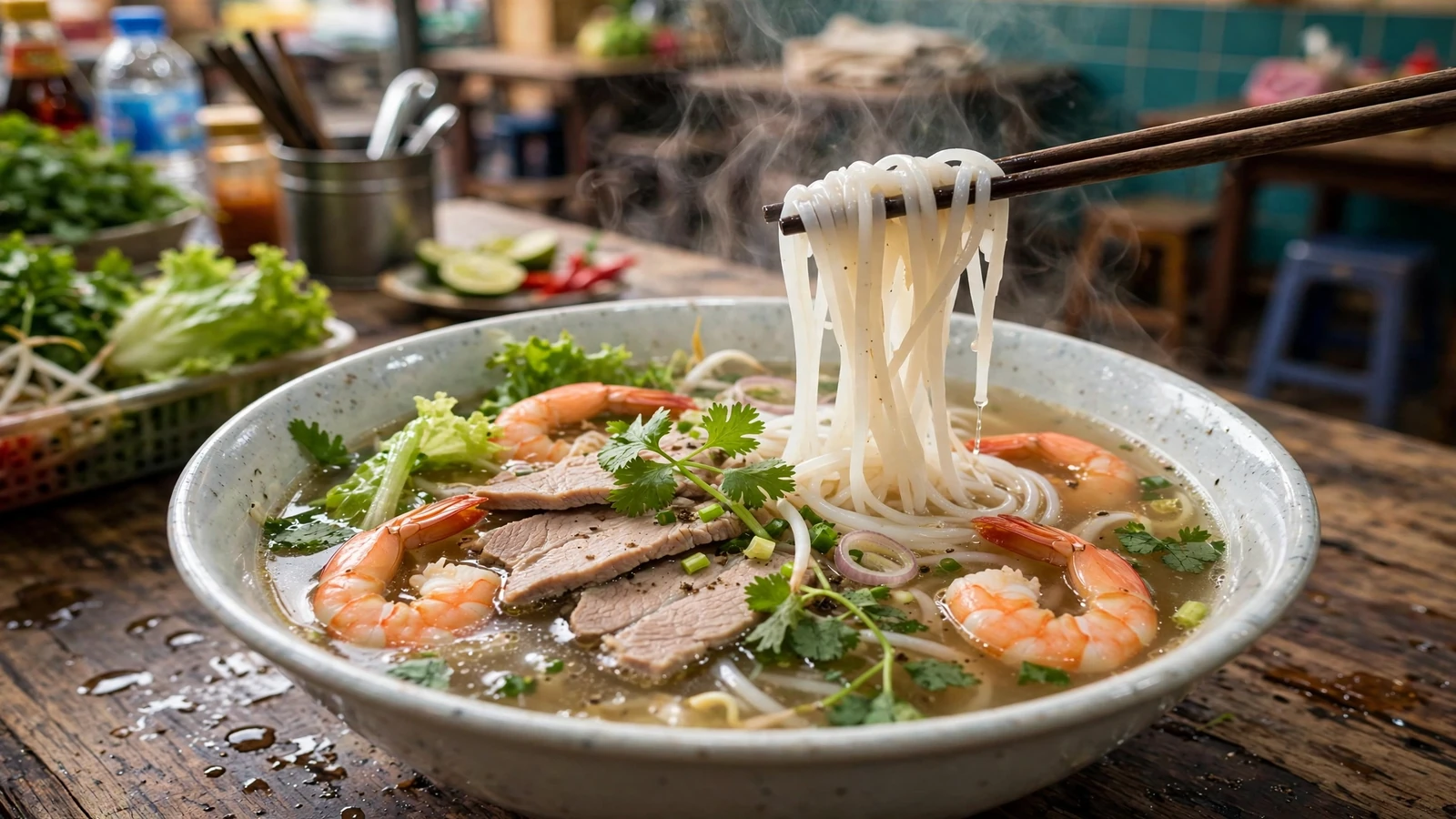
Long before pho conquered the world, Saigon fell for hu tieu Nam Vang, a clear pork and seafood noodle soup from Chinese Cambodian kitchens. Chewy thin noodles, a delicate broth, and a dry version locals love make it essential tasting. Here is where to find it and how to order.
AI illustration
Hu tieu Nam Vang carries its history in its name. "Nam Vang" is the old Vietnamese name for Phnom Penh, the capital of Cambodia, and the dish arrived in Saigon with Chinese Cambodian immigrants who settled in the city generations ago. Saigon adopted it completely, the way it adopts everything delicious, and today it ranks among the city’s most beloved noodle soups. Ordering a bowl connects you to the layered migration story that built modern Saigon.
The broth is the soul of the dish and the first thing that sets it apart from pho. Instead of warm baking spices, hu tieu Nam Vang builds its flavor on pork bones simmered with dried shrimp, dried squid, and sometimes daikon, producing a soup that is crystal clear, deeply savory, and naturally sweet. It tastes clean and delicate rather than spiced, the kind of broth you can drink to the last drop without fatigue. Good shops guard their stockpot recipes like heirlooms.
The noodles are the second signature. They are thin, slightly translucent rice noodles with a springy, chewy bite that holds up in hot broth without turning mushy. Texture matters enormously here. Locals judge a shop by the snap of its noodles as much as by its soup. If pho noodles are soft silk, hu tieu noodles are a firm handshake.
Every hu tieu shop asks one essential question: "nuoc" or "kho"? Hu tieu nuoc is the soup version, with noodles, toppings, and greens all swimming together in the clear broth. It is comforting, aromatic, and the best choice for a first bowl, because you taste the dish exactly as its creators intended. On a cool morning or a tired evening, a steaming bowl of hu tieu nuoc is hard to beat.
Hu tieu kho, the dry version, is where many Saigon locals pledge their loyalty. The noodles are tossed in a savory sauce, usually a blend of soy sauce, oyster sauce, and rendered pork fat, until every strand glistens, then topped with the same meats and garnishes. The hot broth arrives separately in a small bowl for sipping between bites. Eating it dry lets you appreciate the chew of the noodles and the punch of the seasoning directly, with the clear soup as a refreshing counterpoint.
Choosing between them is a delicious dilemma with no wrong answer. First timers should start with nuoc to understand the broth, then try kho on the next visit to compare. Regulars often pick by weather and mood: soup for comfort, dry for intensity. Either way, say the word clearly when ordering, since the kitchen treats them as two different dishes.
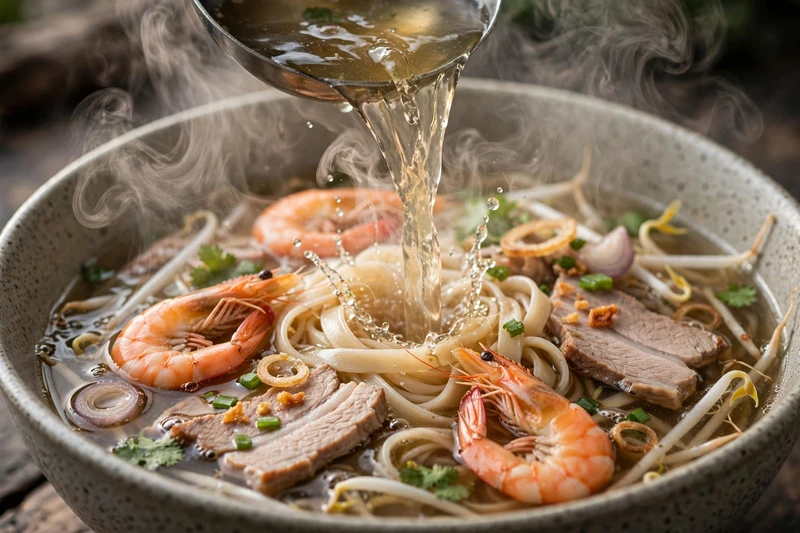
A proper hu tieu Nam Vang arrives loaded. Expect slices of tender pork loin, seasoned minced pork formed into small savory crumbles, and plump shrimp, with some shops adding squid or thin slices of pork liver for the adventurous. The combination of land and sea in one bowl reflects the dish’s coastal Chinese Cambodian roots. Everything is cooked just before serving, so the shrimp stay snappy and the pork stays juicy.
The garnishes add the fresh contrast that keeps the rich bowl balanced. Crisp lettuce, bean sprouts, sliced scallions, and golden fried shallots are standard, and many shops add tan o, chrysanthemum greens with a pleasantly bitter edge that cuts through the pork fat. A wedge of lime and fresh chili sit on the side. Squeeze the lime over the bowl and add chili to taste, but go easy at first. The broth’s delicate savor is easily overwhelmed.
Condiments deserve a moment of your attention. Black vinegar, light soy sauce, and chili oil or fresh chili usually share the table. A few drops of black vinegar brighten the pork beautifully, while soy sauce deepens the savory notes. Add them gradually and taste between additions, because the kitchen has already seasoned the bowl with care and heavy handed doctoring can unbalance it.
Hu tieu Nam Vang belongs to District 5 and the Cho Lon area, Saigon’s historic Chinatown, where Chinese Cambodian families have run noodle shops for generations. The streets here hold the city’s deepest concentration of great bowls, often in unassuming storefronts with steaming pots and stacks of porcelain bowls out front. Wandering Cho Lon in the morning, following the smell of pork broth, is one of Saigon’s finest food pilgrimages. Late night shops in the same neighborhoods serve night owls and shift workers.
Ordering is straightforward. "Mot hu tieu Nam Vang nuoc" gets you the soup version. Swap in "kho" for the dry version. Pointing at the menu or at a bowl on a nearby table works perfectly, and most shops understand a smile plus a raised finger. The food arrives fast, often within minutes, with chopsticks, a Chinese style spoon, and a small dish for mixing your dipping condiments.
Expect to pay 50,000 to 70,000 VND (about $2.00 to $2.80) for a standard bowl and 70,000 to 85,000 VND (about $2.80 to $3.40) for a large or seafood heavy version, with prices checked in 2026 and variable. Many shops open as early as 6:00 for breakfast and stay open past midnight, making hu tieu one of Saigon’s most reliable meals at any hour. Pair it with iced tea and eat slowly. This is a bowl that rewards attention.
It is the old Vietnamese name for Phnom Penh, the capital of Cambodia. The name marks the dish’s origin among Chinese Cambodian immigrants who brought it to Saigon generations ago.
Neither is objectively better. They are different experiences. The soup version showcases the clear, savory broth, while the dry version highlights the chewy noodles and bold seasoning. Locals are evenly split, so try both and join the debate.
The broth is the main difference: hu tieu uses a clear pork and seafood stock without pho’s warm spices, and its noodles are thinner and chewier. The topping style, with minced pork and shrimp, also reflects its Chinese Cambodian roots rather than Vietnamese beef traditions.
 Keep exploring
Saigon pho is sweeter and herbier than Hanoi pho. This guide covers pho bo vs pho ga, how to eat it step by step, and wh
 Keep exploring
Com tam is Saigon’s signature lunch: broken rice with grilled pork chop, shredded pork skin, and egg meatloaf. Learn how
 Keep exploring
From street carts to a UNESCO heritage nomination, Saigon banh mi is the street food you cannot skip. Crispy crust, rich
