You do not need to speak Vietnamese to travel in Vietnam, but a dozen well placed phrases will change how the country treats you. Prices soften, directions get more enthusiastic, and food tastes better when you ordered it with a grin. Vietnamese is tonal, so your accent will be charming rather than correct, and that is exactly the point. This guide gives you the phrases that matter, with pronunciation hints that get you close enough.
AI illustration
Start with Xin chao (sin chow), the universal hello. It works morning to night, for vendors, drivers, and hotel staff alike. Follow good service with Cam on (gahm uhn), thank you, and you will see faces light up. Excuse me is Xin loi (sin loy), useful when squeezing past in a crowded market or catching a waiter’s eye. Yes is Vang (vung) in the north or Da (yah) in the south, and no is Khong (kohng), though Vietnamese speakers often answer negative questions in ways that confuse beginners, so pair it with a clear gesture.
Two phrases carry outsized weight. Xin chao is expected, but adding a slight bow of the head when greeting older people shows respect that gets noticed. And when someone helps you, Cam on nhieu (gahm uhn nyew), thank you very much, costs nothing and buys genuine warmth. If you only memorize three phrases from this whole guide, make them Xin chao, Cam on, and Xin loi.
A note on tones: Vietnamese has six of them, and the same syllable can mean completely different things depending on pitch. Do not let this intimidate you. Context does most of the work, Vietnamese people are generous with struggling beginners, and pointing at the menu while saying the words covers most food situations. Aim for friendly, not flawless.
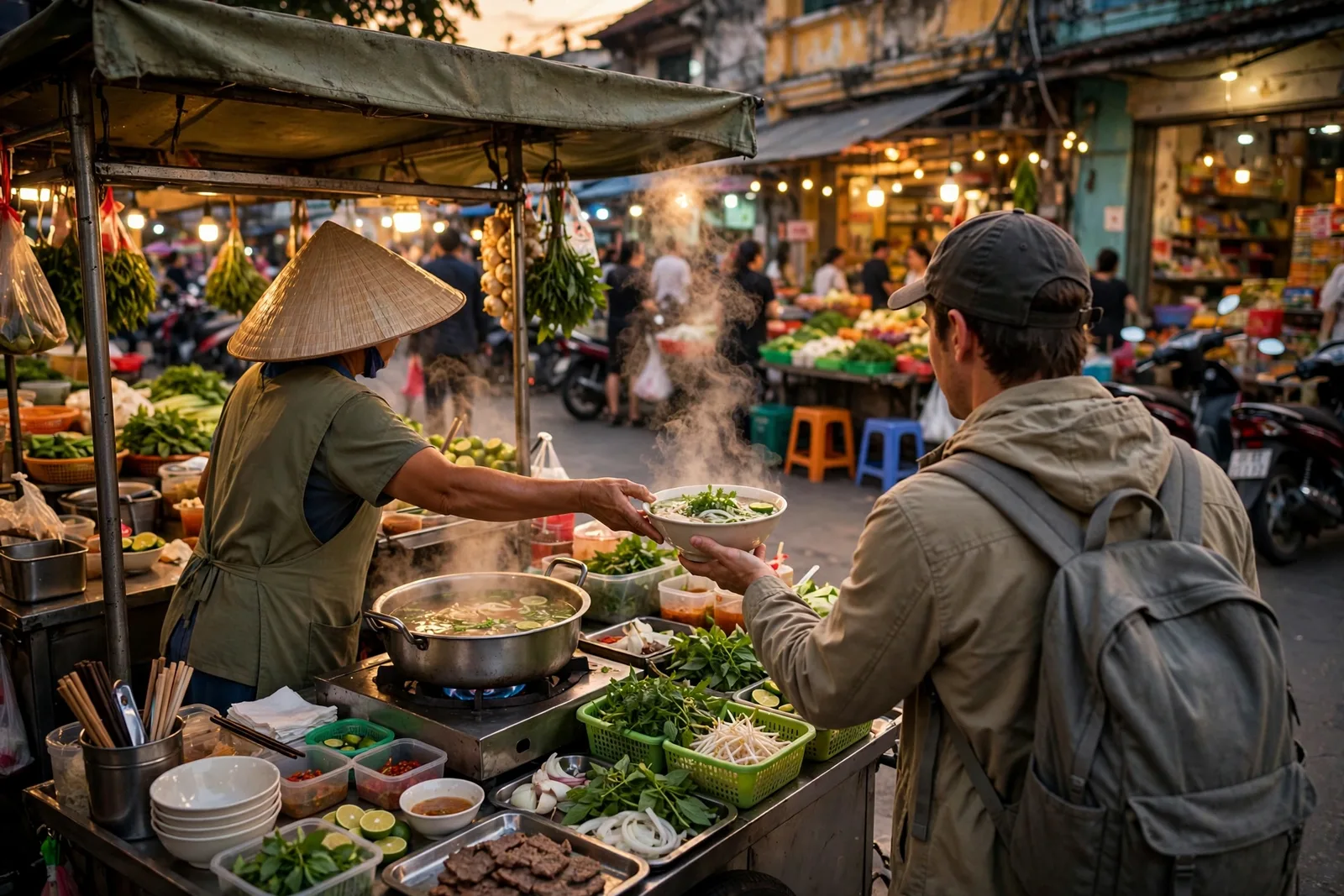
Food is where your phrases earn their keep. Ngon qua (ngon kwah), so delicious, said to the cook, is the highest compliment a traveler can pay and often earns you an extra spring roll or a proud photo together. To order iced coffee with condensed milk, the fuel of Saigon, say Mot ca phe sua da (moht gah feh soo ah dah). A plain black iced coffee is Ca phe den da (gah feh den dah). Read our Vietnamese iced coffee guide before your first cafe stop and you will order like a regular.
When the meal ends, Tinh tien (tin tee en) asks for the bill, literally count money. If the food is too spicy, Khong cay (kohng kai), not spicy, said with a hopeful smile, sometimes helps, though Vietnamese tolerance for heat varies by region and the south is gentler than the center. Cheers is Mot, hai, ba, yo (moht, hi, bah, yaw), one, two, three, yo, and you will hear it shouted across beer halls all evening.
Vegetarians should learn Chay (chai), vegetarian, as in Com chay (guhm chai), vegetarian rice meal. Buddhist vegetarian restaurants, marked by the word Chay on the sign, are common and excellent, especially around the full moon. Pointing works everywhere, but saying the words turns a transaction into a conversation.
In markets, open with Bao nhieu tien (bow nyew tee en), how much. The first price quoted to a tourist is an invitation to negotiate, not a final offer. If it feels steep, smile and say Dat qua (dat kwah), too expensive, then name your counter price or start walking slowly. Walking away politely is the most powerful bargaining tool you own, and vendors will often call you back with a better number. Our Saigon shopping guide covers where bargaining is expected and where prices are fixed.
Keep the tone light throughout. Bargaining in Vietnam is a social game, not a confrontation, and the vendor who laughs with you will give you a better price than the one you tried to pressure. Mac qua (mahk kwah) is a softer version of too expensive, handy when you want to stay friendly. Once you agree on a price, the deal is the deal, so only bargain if you genuinely intend to buy.
Numbers help: Mot (moht) one, Hai (hi) two, Ba (bah) three, Bon (bohn) four, Nam (nuhm) five, Muoi (moo ee) ten. Vendors will often type the price into a calculator or phone to show you, which removes all ambiguity. Learn these five numbers and half your market negotiations become smooth.
For directions, Nha ve sinh o dau (nyah veh sin uh dow) asks where the toilet is, a phrase with endless uses. Di thang (dee tahng) means go straight, Re trai (reh chai) turn left, Re phai (reh fai) turn right. Show your driver the address on your phone rather than pronouncing Vietnamese street names, since tones make them nearly unrecognizable to local ears when beginners say them.
Cuu toi (koo oo toy) means help me, and I need a doctor is Toi can bac si (toy kuhn bahk see). Hopefully you never need these, but save them in your phone notes alongside the emergency numbers 113, 114, and 115. For everything else, the combination of a phrase, a smile, and Google Translate’s camera mode for menus and signs will carry you through the country with ease.
One last phrase for the road: Hen gap lai (hen gahp lai), see you again. Say it to the hotel staff, the pho lady, the Grab driver who waited while you found your wallet. Vietnam rewards travelers who try, and trying starts with a single Xin chao.
In tourist areas, hotels, and restaurants in big cities, yes. Outside those bubbles, very little. Your phrases matter most in markets, small towns, and rural areas.
Not as a short term visitor. Aim for clear, friendly pronunciation and let context do the work. Vietnamese speakers are patient with beginners.
Cam on, thank you. Said sincerely and often, it opens more doors than any other phrase on this list.
Mot, hai, ba, yo. You will hear it constantly in beer halls and sidewalk drinking spots, and joining in is always welcome.
 Keep exploring
Vung Tau sits about 100 km from Ho Chi Minh City. Compare the expressway, the coastal road, and the ferry, and pick the
 Keep exploring
From walkable District 1 to buses, ride hailing apps, and coaches to the coast, here is how to move through the new Ho C
 Keep exploring
Vietnam visa rules for 2026: who gets visa free entry, how the 90 day e-visa works, official costs, and mistakes that ge
