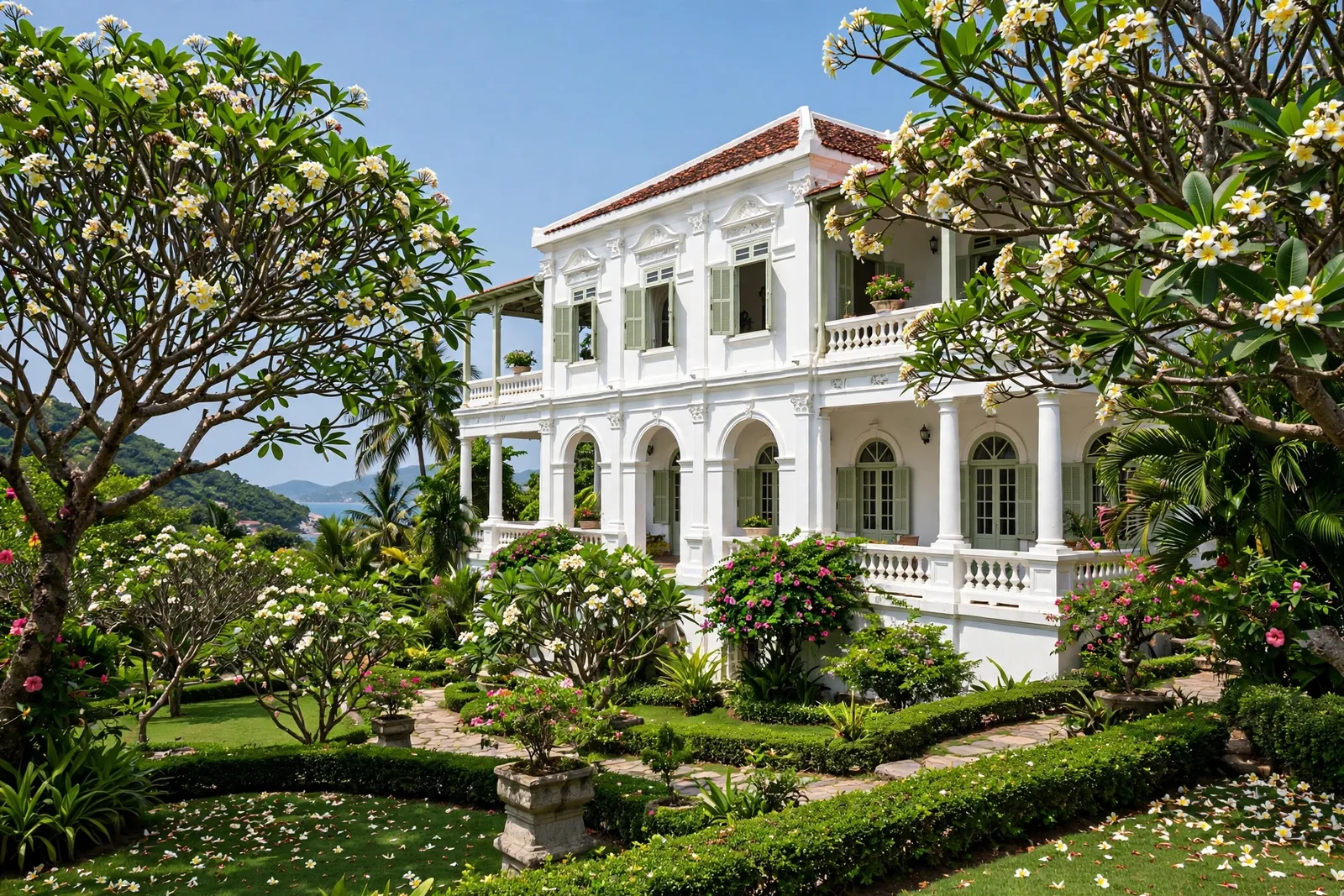
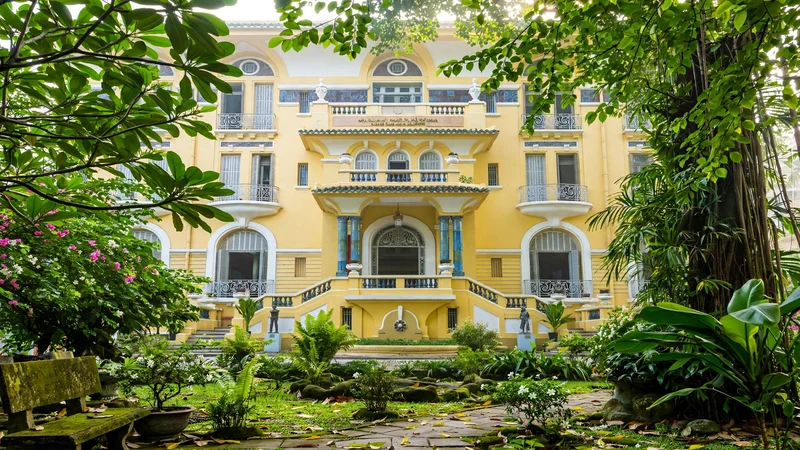
Above Front Beach, half hidden in frangipani trees, stands the grandest colonial villa in Vung Tau. Bach Dinh has been a governor retreat, an emperor prison and now a museum: three lives in one white building.
AI illustration
Bach Dinh, the White Palace, was built between 1898 and 1916 as a seaside retreat for Paul Doumer, the French Governor General of Indochina, who named it Villa Blanche after his daughter. It later served as a favored holiday villa for French governors, and its guest list reads like a roll call of 20th century Vietnamese history.
The villa darkest chapter came when Emperor Thanh Thai was held here for about a decade in the early 1900s, a prisoner in a palace. Later it hosted Emperor Bao Dai and the presidents of South Vietnam. In 1992 it was recognized as a national historical and cultural relic and opened as a museum.
That layered past is what makes a visit interesting. This is not just a pretty building: every room has hosted power, exile or both, and the guides tell the stories well.
Paul Doumer, who commissioned the villa, never actually lived in it: he was recalled to France before completion and later became President of France. The villa was finished under his successors and used by French governors general from 1916. That odd footnote, a palace built for a man who never came, sets the tone for a building that has always belonged more to history than to any one resident.
The villa blends French colonial and faintly Greek influences into something distinctly tropical. Three floors rise 19 meters, wrapped in verandas with arched windows and decorative moldings, all painted the white that gives the palace its name. The proportions are elegant rather than grand: a retreat, not a fortress.
Inside, the rooms keep their period character: tiled floors, shuttered windows, antique furniture and portraits of the residents and rulers who passed through. The sweeping staircase and the verandas are the most photographed spots, especially in the morning light.
Do not miss the details the builders added for the climate: deep eaves, high ceilings and cross breezes that keep the villa cool without air conditioning. It is colonial architecture adapted to the tropics at its most graceful.
The verandas deserve a slow circuit. From the upper terrace the view sweeps from Hon Ba islet across Front Beach to the lighthouse hill, the whole of Vung Tau laid out like a model. The original tilework, with its French makers marks still visible, and the wooden shutters, many of them original, reward close looking. Bring a wide angle lens: the interiors are compact and the light is beautiful.
Today the villa houses a museum of ceramics recovered from ancient shipwrecks off the Vung Tau coast. The collection includes Chinese porcelain and stoneware dating back centuries, salvaged from merchant vessels that sank on the maritime silk route. The pieces are beautiful and the story of their recovery is half the exhibit.
Explanatory panels in Vietnamese and English trace the trade routes that passed this cape and the archaeology of the wrecks. It is a compact museum: 45 minutes covers it well, though ceramics lovers will linger.
Guided tours in Vietnamese run 150,000 to 300,000 VND and add the human stories behind the rooms. English speaking guides can sometimes be arranged through the ticket office if you ask ahead.
The ceramics span several centuries of trade, from sturdy stoneware jars to refined blue and white porcelain. Labels explain which wreck each piece came from and the routes the ships sailed, connecting Vung Tau to ports from Canton to the Middle East. For a small provincial museum, the collection punches well above its weight.
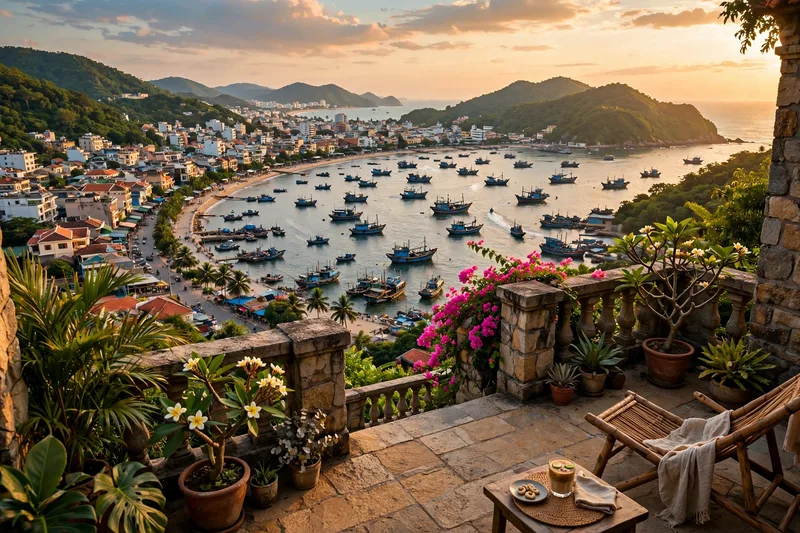
The grounds are half the reason to come. Frangipani trees, some decades old, shade the lawns and fill the air with scent in the flowering season. Stone paths wind past flower beds and old cannons to the terrace at the front, which frames one of the finest views in Vung Tau: Front Beach curving below, the bay dotted with boats, the city climbing the hills.
Come in the late afternoon when the light softens and the heat eases. Photographers get the villa glowing and the bay at its bluest. The site is quiet on weekdays; weekends bring wedding photo shoots, which tells you something about the setting.
Combine Bach Dinh with Front Beach below or the Small Mountain viewpoints nearby. All three fit in a relaxed half day, and our getting to Vung Tau guide covers the journey from the city.
The ticket office sells a small illustrated guidebook in English for a few thousand dong, a nice souvenir that explains the villa rooms in more detail than the wall panels.
15,000 VND per person, one of the cheapest museum tickets in Vietnam.
Daily about 7:00 to 17:00, sometimes with a midday break. Mornings are best.
Ceramics from ancient shipwrecks, plus period rooms from the villa history.
On Tran Phu street above Front Beach, a short taxi or Grab ride from anywhere in Vung Tau.
 Keep exploring
Back Beach (Bai Thuy Van) runs nearly 8 km along Vung Tau, about 2 hours from Ho Chi Minh City. Free entry, gentle surf,
 Keep exploring
Dam Trau Beach sits 12 km from Con Dao town, backed by old forest and fronted by coral just meters from shore. Free entr
 Keep exploring
Founded in 1975, the War Remnants Museum documents the Vietnam War through aircraft, tanks, and thousands of photographs
