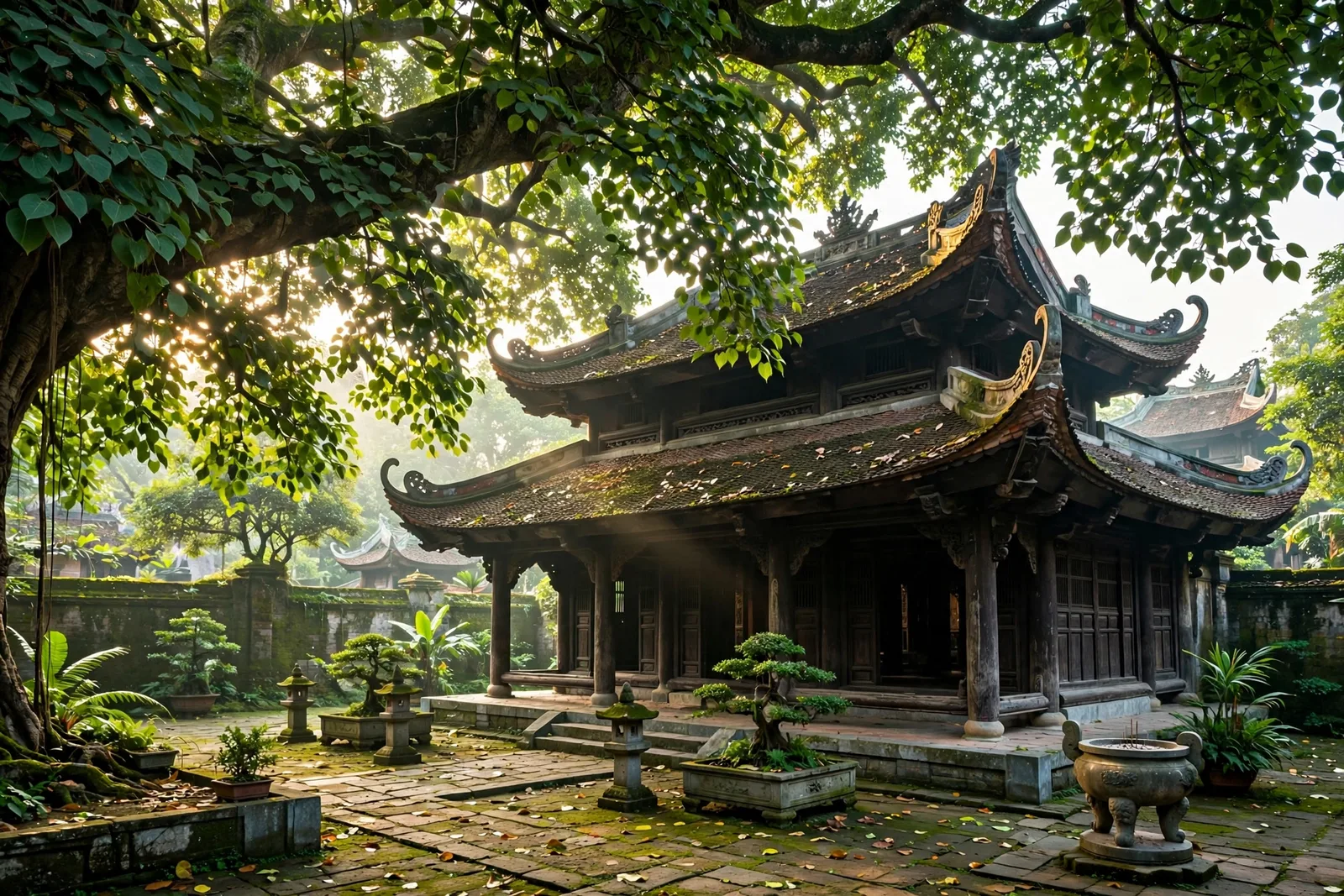
Before Saigon was Saigon, there was Giac Lam. Founded in 1744, it is the oldest temple in Ho Chi Minh City, older than the city’s French boulevards by more than a century. Its dark wooden halls, shaded by a great bodhi tree, hold 280 years of prayer in a compound that still feels like a village sanctuary.
AI illustration
Giac Lam was founded in 1744 by the monk Phat Y, when this area was still countryside outside the Gia Dinh citadel. It has survived wars, regimes, and the city’s explosive growth, remaining an active place of worship through every upheaval. The buildings you see today are mostly 19th and early 20th century, built in the traditional southern Vietnamese temple style. Consider what that span means: this temple was already old when the French arrived, already ancient when the Americans came, and still it keeps its morning chanting schedule.
The main hall is a masterpiece of wooden architecture: dark jackfruit wood columns, intricately carved altars, and a roof of curved tiles that has sheltered generations of monks. The patina of age here is real, not restored, and the hall smells of old wood and incense in a way no new building can imitate. Run your eyes along the carved panels and you can trace the hands of craftsmen dead two centuries, their chisel marks still crisp in the dark wood.
The complex also holds a revered collection of old statues, bronze bells, and woodblock sutras, some dating back centuries. It functions as a quiet museum of Vietnamese Buddhist art, though nothing is labeled like one; ask a resident monk or guide to point out the highlights. The bronze bells, green with age, still ring for ceremonies, their tones deeper and stranger than any modern casting.
The great bodhi tree in the courtyard is itself a pilgrimage object, grown from a cutting of the tree under which the Buddha attained enlightenment. Its wide canopy shades the main courtyard, and prayer ribbons tied to its lower branches flutter in every breeze. Sit beneath it for a few minutes; the calm is the point. The aerial roots hang like curtains, and the dappled light on the courtyard stones makes this one of the most peaceful spots in the city.
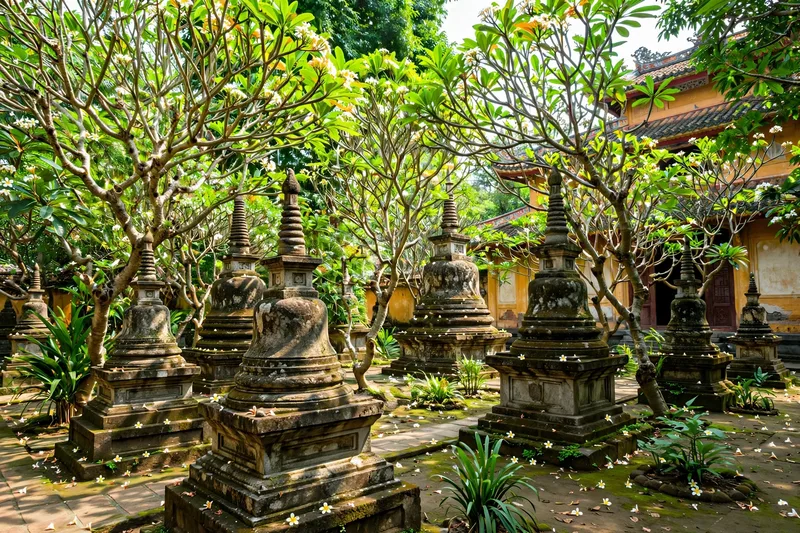
The grounds include stupas of former abbots, their towers rising among frangipani trees, and small shrines tucked into corners. The whole compound has the hushed feeling of a place that has been quiet for a very long time, even as the city roars a few streets away. Each stupa marks a life devoted to this place, and together they form a small forest of memory.
Unlike the tourist facing temples, Giac Lam receives few foreign visitors, which means you will likely share the halls with local worshippers rather than tour groups. That authenticity is its greatest charm and its greatest demand: behave as a guest in someone’s sacred space. The absence of crowds is a privilege, not a right, so earn it with quiet respect.
Modest dress is essential: shoulders and knees covered, hats off inside. Speak softly, step over thresholds, and do not point your feet at altars when sitting. Photography of the architecture is fine; photographing people at prayer requires permission. These are not tourist rules but the basic manners of a 280 year old house of worship, and they cost nothing to observe.
The temple is most alive in the early morning, when monks chant and local devotees bring offerings. Midday is quietest. Allow forty five minutes to an hour to see the halls, the stupas, and the bodhi tree properly. The morning chanting, starting around 5 am for the dedicated, fills the wooden hall with a resonance that has to be heard to be believed.
To complete the city’s temple trio, pair Giac Lam with the Jade Emperor Pagoda and Vinh Nghiem Pagoda, each representing a different century and style of worship. Oldest to newest, Taoist to Mahayana, the three form a timeline of faith you can walk in a single day.
Giac Lam sits in Tan Binh, a district most tourists never enter, and the streets around the temple are worth a wander. Local markets, sidewalk coffee stalls, and shophouses unchanged for decades give you the unfiltered city. This is Saigon without the filter: laundry lines, repair shops, noodle carts, and the daily theater of a working neighborhood.
The area’s food is resolutely local: bun bo Hue shops, banh canh noodle stalls, and che dessert carts, all at neighborhood prices. Lunch here after the temple is one of the cheapest good meals you will eat in Saigon. The banh canh stalls, with their thick tapioca noodles in rich crab broth, are worth the trip alone.
From Giac Lam, Cho Lon is a short ride southwest, making a morning temple plus afternoon Chinatown combination that covers the city’s deepest historical layers in a single day. Two and a half centuries of history, from the 1744 temple to the 19th century shophouses, in one unhurried arc.
Founded in 1744, making it the oldest temple in Ho Chi Minh City at over 280 years old. The current buildings are mostly 19th and early 20th century.
At 118 Lac Long Quan Street in Tan Binh District, about 15 to 20 minutes by taxi west of District 1.
No, entry is free. Donations to support the temple are welcome.
It was grown from a cutting of the bodhi tree under which the Buddha attained enlightenment, making it a revered object of pilgrimage in its own right.
 Keep exploring
Back Beach (Bai Thuy Van) runs nearly 8 km along Vung Tau, about 2 hours from Ho Chi Minh City. Free entry, gentle surf,
 Keep exploring
Dam Trau Beach sits 12 km from Con Dao town, backed by old forest and fronted by coral just meters from shore. Free entr
 Keep exploring
Founded in 1975, the War Remnants Museum documents the Vietnam War through aircraft, tanks, and thousands of photographs
