Vietnam has some of the cheapest mobile data on earth, and getting connected takes ten minutes. The only real decision is where to buy your SIM and which network to pick. This guide covers airport counters, city shops, eSIMs, and the wifi situation across the country.

AI illustration
Three networks cover Vietnam, and the differences matter once you leave the cities. Viettel has the widest coverage by far, reaching remote corners of the highlands and islands where the others fade. If your trip includes Da Lat, the Mekong backwaters, or Con Dao, Viettel is the safe pick.
Vinaphone and Mobifone perform well in cities and along main tourist routes, sometimes with slightly faster urban speeds. For a trip confined to Saigon, Hoi An, and Hanoi, any of the three will serve you fine. Price differences between them are negligible at tourist SIM level.
All three sell 4G widely and 5G in major cities. Real world speeds are excellent: video calls, hotspot tethering, and navigation all work without drama. Vietnam's mobile internet is genuinely better than in many wealthier countries, and dramatically cheaper.
Coverage maps flatter every network, so trust traveler reports over marketing. In practice, Viettel holds signal on mountain roads and islands where the others show full bars and deliver nothing. For a beach and city itinerary the difference is minor; for an adventure itinerary it is decisive.
The arrivals hall at Tan Son Nhat has official counters for all three networks, and buying there is the smoothest option. Staff speak English, activation takes minutes, and you walk out with working data before you reach the taxi queue. Expect to pay 150,000 to 350,000 VND (about $6 to $14) for a 30 day tourist package with 30 to 60 GB.
City shops are slightly cheaper but require more effort. Official carrier stores need your passport for registration, which is legally required for all SIMs, and the process can take twenty minutes with translation friction. Street vendors sell SIMs faster and cheaper, but the packages are sometimes misrepresented, so inspect what you are buying. Ask to see the data allowance printed on the package before you pay; legitimate tourist SIMs list the gigabytes clearly.
Bring your passport either way. Registration is the law, and legitimate sellers will ask for it. Our airport arrival guide maps exactly where the counters sit in the arrivals hall.
If your flight lands after midnight, the airport counters may be closed or running reduced staff. Buy an eSIM before departure as insurance, or grab a SIM at your hotel the next morning. District 1 has carrier stores on nearly every major street.
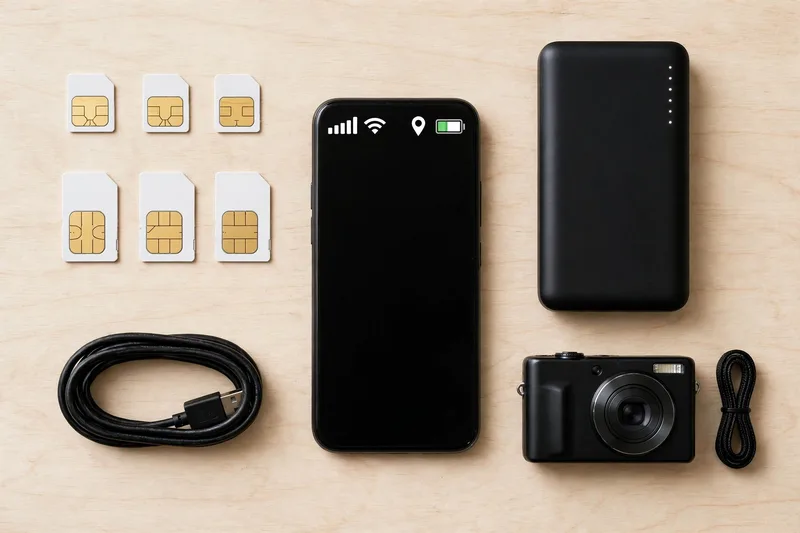
If your phone supports eSIM, you can land already connected. Providers like Airalo and regional sellers offer Vietnam data packages from $5 to $15, installable before departure. The convenience is real, though per gigabyte prices run higher than local SIMs and speeds depend on the partner network.
Check compatibility first: many phones sold in certain markets have eSIM disabled, and dual SIM setups behave differently across brands. If your phone is eSIM capable and unlocked, it is the zero hassle option for short trips.
Hotel and cafe wifi is abundant and generally fast, so wifi only travel is survivable in cities. But Grab, maps, and translation need data on the street, where the trip actually happens. For the price of two coffees, a local SIM removes an entire category of travel friction.
Pocket wifi devices, rented at the airport, suit groups sharing one connection. They cost more than a SIM and add a device to charge, but they keep everyone's home number active for calls. For most travelers, a local SIM plus hotspot is simpler and cheaper.
Top ups are trivial. Carrier apps, convenience stores, and street vendors all sell credit, and most tourist packages include enough data that you will never need to. If you do run low, 50,000 VND (about $2) buys a generous top up almost anywhere.
Hotspotting works on all tourist packages, so one SIM can serve a laptop and a partner's phone. Speeds hold up well for video calls even on 4G. Just watch your battery: navigation plus heat plus tethering drains phones fast, so carry a power bank.
Keep your home SIM safe and note its number. You will want it for two factor authentication codes from your bank, which brings us to money and ATMs: with data working from minute one, mobile banking and Grab payments just work.
When you leave Vietnam, the SIM dies with the trip. Tourist packages expire after 30 days without top up, so there is nothing to cancel. Keep the SIM ejector tool from your phone box; you will need it to swap your home SIM back in at the airport.
150,000 to 350,000 VND (about $6 to $14) for 30 days with 30 to 60 GB of data, bought at the airport.
Viettel has the widest coverage, especially outside cities. Vinaphone and Mobifone are fine for city focused trips.
Yes, if your phone supports eSIM and is unlocked. Packages cost $5 to $15 online, though local SIMs are cheaper per gigabyte.
Yes. SIM registration with a passport is legally required at legitimate sellers.
 Keep exploring
Vung Tau sits about 100 km from Ho Chi Minh City. Compare the expressway, the coastal road, and the ferry, and pick the
 Keep exploring
From walkable District 1 to buses, ride hailing apps, and coaches to the coast, here is how to move through the new Ho C
 Keep exploring
Vietnam visa rules for 2026: who gets visa free entry, how the 90 day e-visa works, official costs, and mistakes that ge
