No first trip to Saigon is complete without Ben Thanh Market, and no market in the city divides opinion like it. Tourists call it a must see and a tourist trap in the same breath. Both are true, which is why you need a strategy: what to buy, how to bargain, where to eat, and when to walk away.
AI illustration
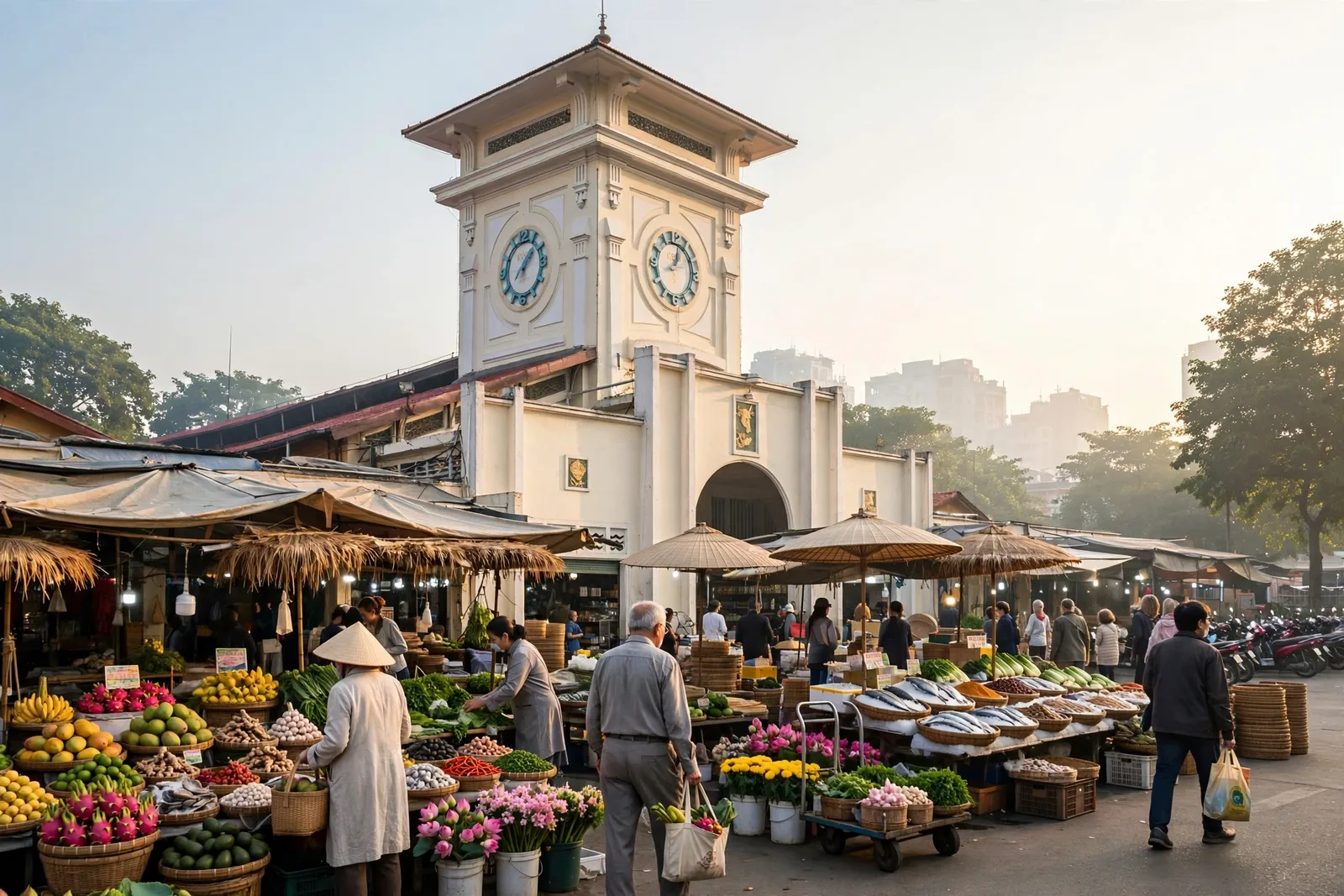
Ben Thanh’s current building dates to 1912, and its clock tower is the symbol of Saigon itself. Inside, the market divides roughly into zones: souvenirs and clothing in the center, food at the edges and in the famous food alley, with produce and household goods filling the gaps. Knowing the layout saves you from wandering in circles. The four gates each face a different street and a different specialty, so note which gate you entered through or you will exit somewhere unexpected.
Prices here start high because the first offer assumes you will bargain. The same lacquerware, coffee, or t-shirt costs significantly less at local markets like Ho Thi Ky or Cho Lon’s Binh Tay Market, so treat Ben Thanh as the convenient option, not the cheap one. You pay for location. That said, the convenience is real: no other market in the city packs this much variety this close to the hotels.
The market opens around 7 am and runs to about 6 pm, with the night market taking over the surrounding streets in the evening. Morning is best for food and photos; late afternoon is best for bargaining, when vendors would rather sell than pack up. The light through the market’s high windows is beautiful before 9 am, slanting across the stalls in dusty beams.
Bargaining at Ben Thanh is expected and friendly, not confrontational. A good rule: offer 50 to 60 percent of the first price, meet around 70 percent, and smile throughout. If the vendor will not move, thank them and walk away slowly; the price often drops before you reach the aisle’s end. The walk away is the single most powerful tool in your kit, and vendors expect you to use it.
Decide your walk away price before you start, and mean it. The vendors are professionals who read hesitation instantly. Comparing prices at three stalls before buying anything gives you the real market rate in ten minutes. The first stall is for learning, the second for confirming, the third for buying.
Keep it light and keep moving. The vendors who chase you down the aisle are the ones with the most margin to give. And remember: a dollar saved on a souvenir is not worth twenty minutes of your vacation. Bargain for the fun of it, then move on. The best bargainers in the market are the ones laughing.
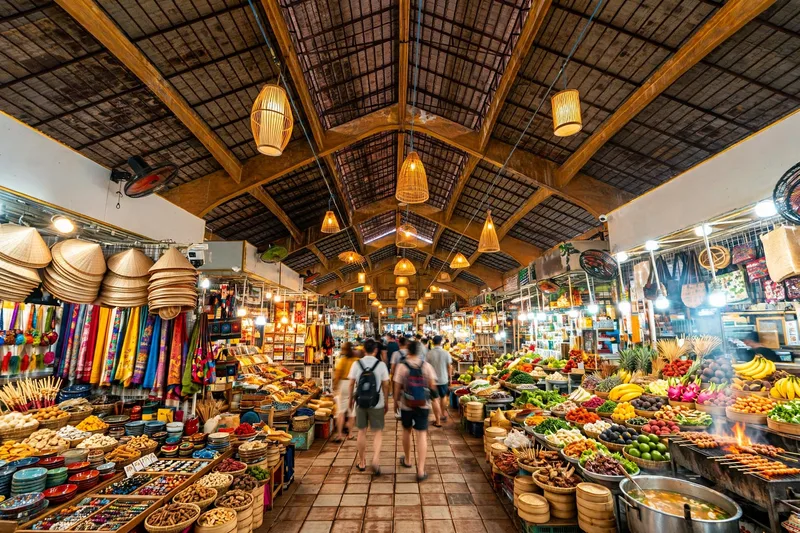
The food is Ben Thanh’s secret weapon. The stalls along the market’s edges and the food alley serve excellent bun bo Hue, banh xeo, goi cuon, and che to a mixed crowd of vendors, office workers, and tourists. Prices are higher than neighborhood stalls but the quality is genuinely good and the variety is unmatched under one roof. The food alley in particular, a narrow lane of stalls along one side, is a destination in its own right.
For the classics before you shop, read up on banh mi, pho, and com tam so you order with confidence. The banh mi stalls outside the market’s main gates are local legends in their own right. The most famous one has a queue that moves fast and a sandwich that justifies the hype.
Drink the fresh juices and the ca phe sua da from the drink stalls; they are cheap, safe, and exactly what you need in the market’s warm halls. Eat where the vendors eat, at the stalls with the longest local queues, and you will eat well. The vendors’ own lunch spots, identifiable by the staff aprons draped over chairs, are the quality guarantee.
Worth buying: Vietnamese coffee and coffee filters, lacquerware, silk scarves, conical hats, and dried fruit. These are good quality, packable, and genuinely local. Coffee in particular is a bargain even at tourist prices. The robusta beans, ground fresh at the coffee stalls, make a souvenir that actually gets used back home.
Skip: anything claiming to be antique, branded goods at impossible prices, and pearls or gemstones you cannot verify. The market’s electronics and “designer” goods are counterfeit as a rule. If a deal looks too good for a luxury brand, it is, and the quality will not survive the flight home.
For serious souvenir hunting at local prices, make the trip to Cho Lon’s Binh Tay Market or Ho Thi Ky, where the same goods cost less and the bargaining starts lower. But for a first day orientation, a morning at Ben Thanh followed by the District 1 walking tour is the classic Saigon opening, and classics exist for a reason. Do Ben Thanh once, do it well, then graduate to the local markets.
Roughly 7 am to 6 pm daily, with a separate night market on the surrounding streets in the evening. Hours shift slightly by stall.
Prices start high and the center aisles target tourists, but the food stalls are genuinely good and bargaining is part of the fun. Go with a strategy and realistic expectations.
Yes, bargaining is expected everywhere except the fixed price food stalls. Start at half the asking price and keep it friendly.
Bun bo Hue, banh xeo, goi cuon fresh spring rolls, che desserts, fresh juices, and the banh mi stalls outside the main gates.
 Keep exploring
Back Beach (Bai Thuy Van) runs nearly 8 km along Vung Tau, about 2 hours from Ho Chi Minh City. Free entry, gentle surf,
 Keep exploring
Dam Trau Beach sits 12 km from Con Dao town, backed by old forest and fronted by coral just meters from shore. Free entr
 Keep exploring
Founded in 1975, the War Remnants Museum documents the Vietnam War through aircraft, tanks, and thousands of photographs
